
Tuesday, November 10, 2026• Medically reviewed November 9, 2026
Why Is Donor Density Important for a Hair Transplant?
What is Donor Density in a Hair Transplant?
The donor area is usually the occipital and parietal scalp, the back and sides of the head. In androgenetic alopecia, follicles here tend to resist pattern hair loss, which is why they keep growing after relocation.
Donor density describes how much hair that region holds, but several different measurements hide under the phrase:
- Follicular-unit Density: follicular units per cm².
- Hair Density: individual hairs per cm².
- Hair Caliber: the diameter of each shaft.
- Hairs per Follicular Unit: whether units carry one, two, three or more hairs.
- Miniaturization: the share of donor hairs that are already thinning.
Current guidance recommends measuring density at several points, along with caliber, miniaturization and the boundaries of the safe donor area.
What is Considered Good Donor Density?
There is no single pass-or-fail number. Published references often describe about 65–85 follicular units per cm² in suitable occipital scalp, with wide individual variation. One recent clinical review treats densities above roughly 80 FU/cm² as favorable and below roughly 40 FU/cm² as less suitable. A candidacy review calls anything under 60 FU/cm² relatively low.
A patient with moderate unit density and coarse, wavy hair can look fuller after surgery than a patient with higher density and fine, straight hair. The figures only make sense when read together with caliber and hair type.
Why does Donor Density Limit How Many Grafts You Can Receive?
Because a transplant moves follicles; it does not create them. Every graft placed in the hairline, mid-scalp or crown was taken from somewhere else.
Practice guidelines list what decides the safe number: donor density, the size of the safe donor area, head size, harvesting technique, skin characteristics, age and the likelihood of future procedures.
The goal is not the maximum number of grafts. It is enough follicles to make a visible improvement while leaving the donor area dense enough to look untouched.
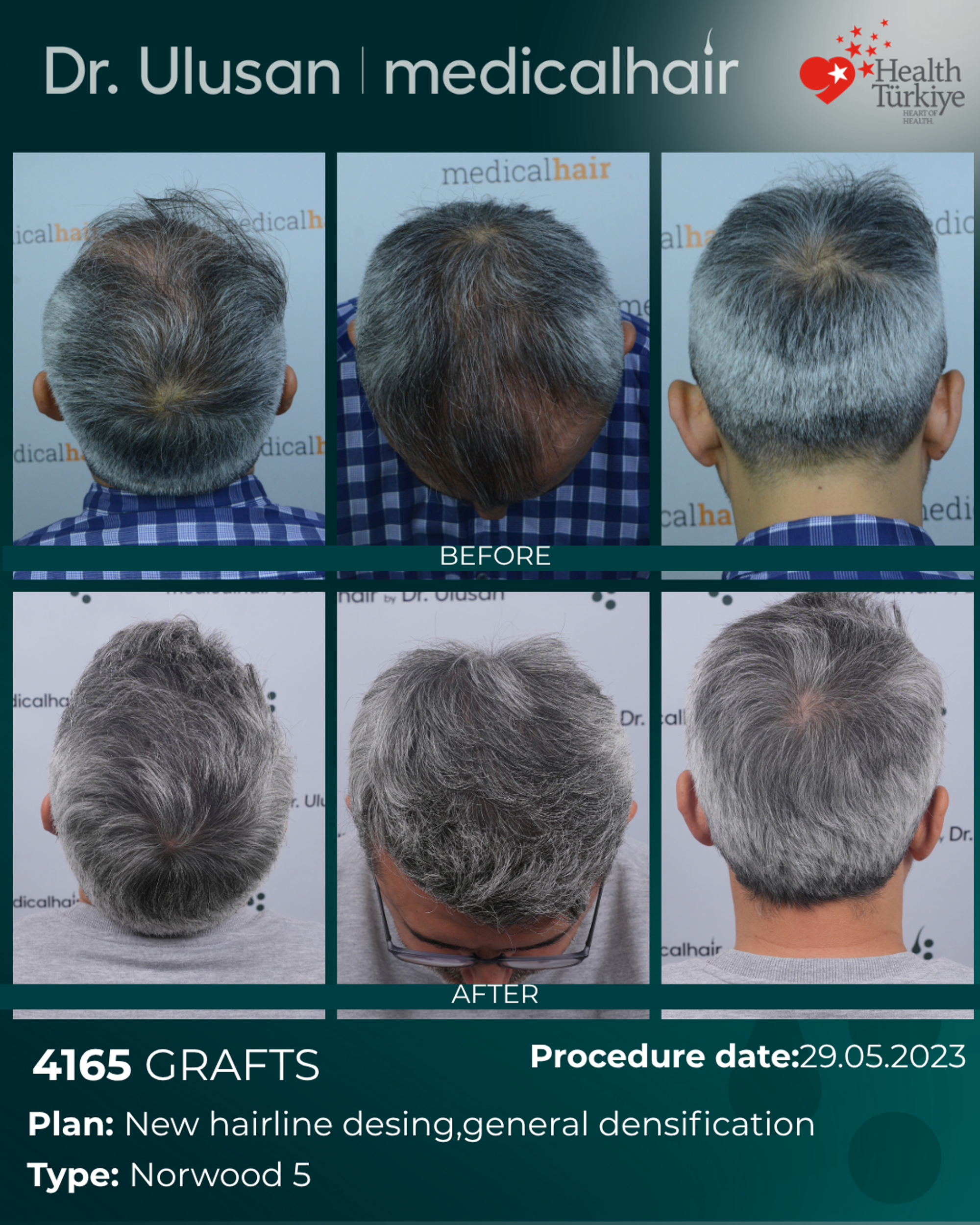
Why does the Number of Hairs per Graft Matter?
Take two hypothetical 2,500-graft sessions. If grafts average 1.8 hairs, that is about 4,500 hairs. At 2.4 hairs per graft, the same 2,500 grafts carry about 6,000 hairs. Same graft count, a third more hair.
So the surgeon should also know the mix of single-, double-, triple-hair and larger units in your donor area. A clinic that advertises only "maximum grafts" is showing you half the picture.
Why are Single-Hair Grafts Used at the Hairline?
The leading edge is made of fine, irregularly spaced single hairs. Single-hair units are therefore reserved for the frontal edge and the temporal transitions, where a soft border is what makes the result believable.
Multi-hair units go behind that edge, where they add density without being seen from the front. Single hairs give the design its realism; multi-hair units supply the thickness. A plan that uses each in the right place often looks better than one that simply uses more grafts.
Get a Donor-Area Beview before you Travel to İzmir
At our clinic in İzmir, Türkiye, we measure donor density at multiple points, assess caliber and miniaturization, and plan the graft count around what your donor area can safely give, including what you may need later.
Patients from Türkiye, Europe and the United States can send clear photographs of the frontal hairline, temples, top, crown, sides and back of the head for a preliminary review. Final candidacy and graft planning require an individual clinical evaluation.
- Hair Transplantationhttps://pubmed.ncbi.nlm.nih.gov/31613520/— PubMed
- Hair Transplant Practice Guidelineshttps://pmc.ncbi.nlm.nih.gov/articles/PMC8611706/?utm_source=chatgpt.com— PubMed
This page is intended for informational purposes only and does not replace professional medical advice. A physician’s evaluation and examination are required for diagnosis and treatment planning.