
Tuesday, August 25, 2026• Medically reviewed August 24, 2026
How Should the Vertex Be Designed During a Hair Transplant?
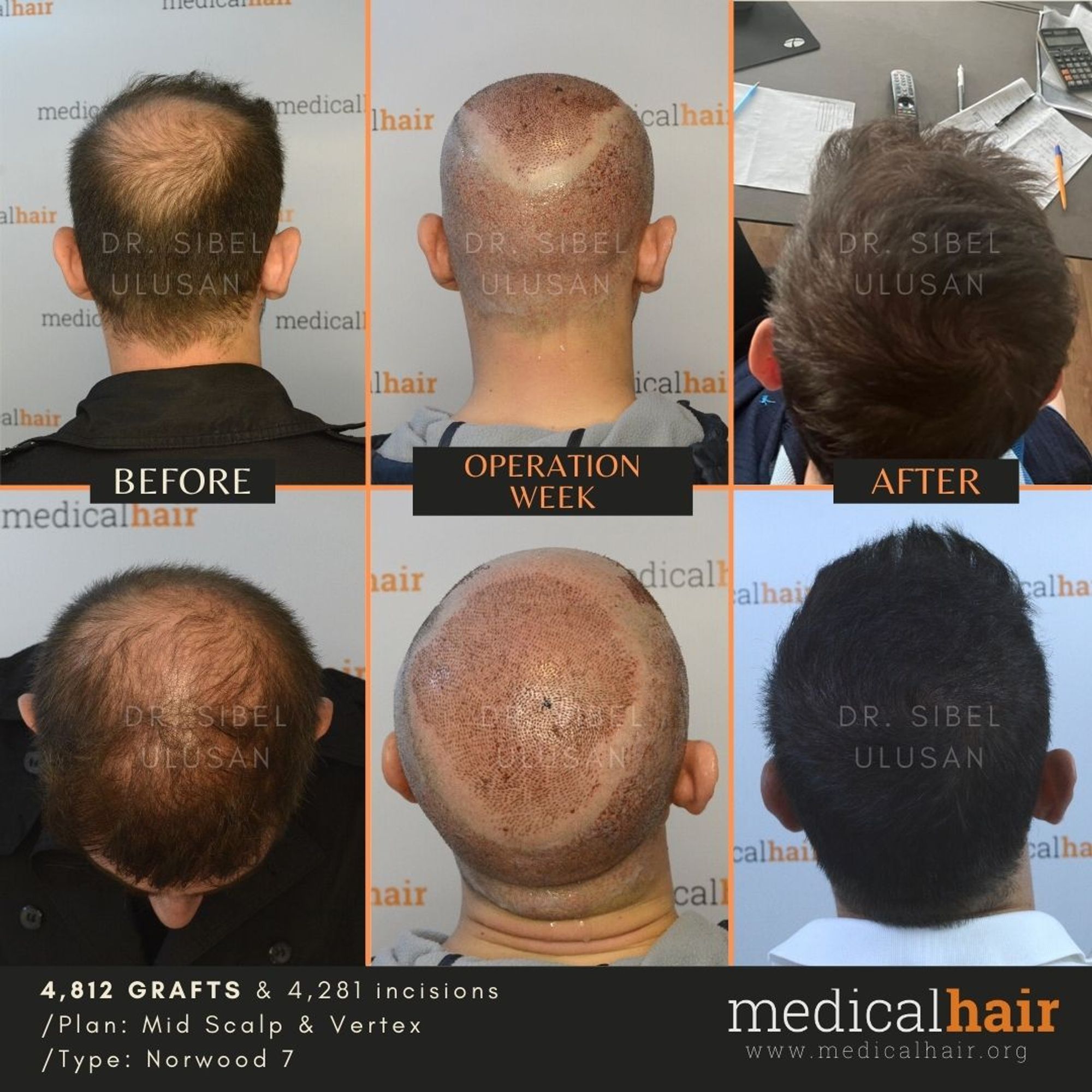
The vertex is one of the most technically demanding areas to restore in hair transplantation. Unlike the frontal hairline, where hairs generally follow a forward direction, vertex hairs usually form a spiral or whorl pattern. Reproducing that pattern convincingly requires careful planning of direction, angulation, coverage, and donor-graft use.
A crown transplant can look dense after graft placement. The goal is therefore not simply to place as many grafts as possible. It is to reconstruct a pattern that behaves visually like a natural crown while preserving enough donor hair for the patient's future needs.
What Makes Vertex Hair Transplant Design Different?
The crown does not have a straight or predictable growth direction. Hairs radiate from a central point and gradually change direction as they move outward. Individual patients may have clockwise or counterclockwise whorls, and the position and shape of the whorl can vary considerably.
Where Should the Center of the Hair Whorl Be Placed?
Whenever native crown hairs remain, they provide the most valuable reference.
Where the existing hairs converge, how the surrounding hairs rotate, and where the transition between the mid-scalp and crown occurs. The transplanted design should generally continue this architecture rather than imposing an artificial new center.
In advanced hair loss, however, the original whorl may be difficult to see. Our surgeon considers scalp anatomy, the remaining peripheral hair pattern, the extent of alopecia, and the possibility that crown loss will expand in the future.
How Much Density Does the Vertex Need?
A transplanted crown does not necessarily need to reproduce the patient's original density to look fuller. What patients perceive as density is influenced by several factors, including:
- hair-shaft thickness;
- hair-to-scalp color contrast;
- curl or wave;
- the number of hairs within individual follicular units;
- the size of the thinning area;
- hair direction; and
- surrounding native density.
These characteristics explain why the same graft number can produce very different visual results in two patients. Someone with thick, wavy hair and relatively low hair-to-scalp contrast may achieve stronger visual coverage than someone with very fine, straight, dark hair against a light scalp using a comparable number of follicles.
What Determines a Natural Vertex Hair Transplant Result?
A successful crown area result is often not defined by the maximum number of grafts. A natural look is achieved by a combination of many small decisions, such as correctly identifying the hair swirl, recreating its natural direction, ensuring smooth transitions, carefully using donor follicles, taking existing hair into account, and planning for future hair loss.
In our clinic, instead of applying the same crown area template to every patient, the vertex design is planned taking into account the individual's existing hair swirl, the degree of hair loss, donor characteristics, and expected future hair loss.
For the initial evaluation, you can send us photos clearly showing your hair from the front, sides, top, crown, and donor area via WhatsApp.
This initial evaluation based on photos can aid in the planning process. However, your suitability for hair transplantation, the required number of grafts, and the surgical design will be finalized after a comprehensive medical evaluation and examination.
- Management of the crownhttps://pubmed.ncbi.nlm.nih.gov/24017981/— PubMed
- Predicting the Permanent Safe Donor Area for Hair Transplantation in Koreans with Male Pattern Baldness according to the Position of the Parietal Whorlhttps://pubmed.ncbi.nlm.nih.gov/24883280/— PubMed
This page is intended for informational purposes only and does not replace professional medical advice. A physician’s evaluation and examination are required for diagnosis and treatment planning.