
Tuesday, November 3, 2026• Medically reviewed November 2, 2026
Can a Hair Transplant Restore the Temples?
Temporal recession, also called bitemporal recession, is the backward movement of the hairline at the temples. It gives the hairline an “M” shape and makes the forehead look wider. In men it is a characteristic early sign of androgenetic alopecia (male pattern hair loss), which can start in the late teens or twenties and progress slowly for years.
A hair transplant can restore the temples in suitable patients, but it only works well when the loss is established, the donor area is strong, and the design allows for hair you have not lost yet.
How Does Temporal Recession Look Like?
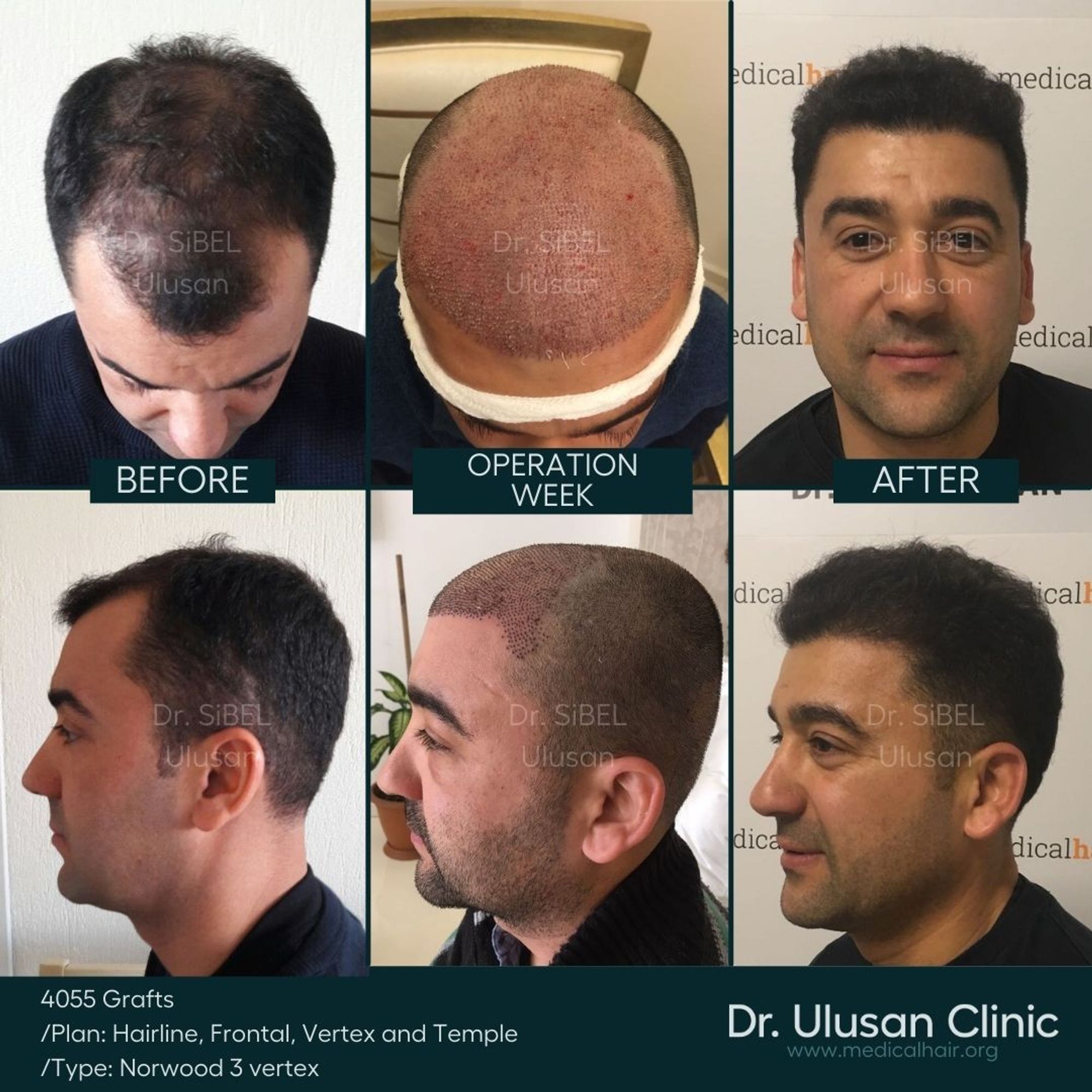
The frontotemporal corners, where the front hairline turns toward the sides of the scalp, move back. The corners deepen, the forehead widens, and density thins around them. With more advanced loss, the temporal points, the forward-pointing triangles of hair above the sideburns, can recede as well.
In the Hamilton-Norwood scale, Norwood II is mild, symmetrical bitemporal recession, and Norwood III shows more significant temple loss. The two sides are often similar but rarely identical. Recession is a description of where hair is lost.
What Can Cause Receding Temples?
Androgenetic alopecia is the most common cause in men, but not the only one. Traction alopecia from tight ponytails, braids or extensions, frontal fibrosing alopecia, alopecia areata, scarring alopecias, previous surgery or trauma, and some forms of female pattern hair loss can all affect the temples.
Gradual recession over several years alongside early crown thinning is typical of androgenetic alopecia. Sudden loss around one temple, especially with redness, scaling, pain or scarring, needs a diagnosis before anyone considers a transplant.
Can Medication Regrow receding Temples?
Sometimes, mainly when follicles are miniaturized rather than gone. Miniaturization means a follicle produces progressively finer, shorter, lighter hairs. At the temples this appears as a zone of weak, wispy hair before the area becomes bald. Medication works best at this stage, and the AAD notes that treatment for hereditary hair loss tends to work better when started early.
Options for adult men include topical minoxidil and oral finasteride, depending on medical suitability. Both are medical decisions, and finasteride is prescription-only with potential side effects that should be discussed with a doctor. The response at the front hairline and temples is often more modest than patients hope. Medication preserves and thickens vulnerable hair far better than it recreates a temple that has been bald for years.
What Makes a Natural-Looking Temple Transplant?
The details are small but visible, especially from the side.
- Angle and direction: Temporal hairs lie flat and point backward and downward. Grafts placed too upright stick out from the scalp, and a few degrees can ruin the result.
- Single-hair grafts at the edge: A natural hairline is soft and irregular at the front, with thicker units behind. Multi-hair grafts at the leading edge look coarse.
- Open corners: Male frontotemporal angles are more defined than the rounded transition typical of a female hairline. Closing them completely gives an artificial, overly round hairline.
- Balance, not mirror symmetry: Faces are asymmetric, and so are natural hairlines. Matching both sides exactly on a ruler can look less natural than respecting the existing difference.
- Three-dimensional design: A line that looks right from directly in front can look wrong from the oblique and the profile. The front hairline and temples should be designed together as one unit.
Temple Restoration in İzmir
At our clinic in İzmir, Türkiye, the temples are assessed as part of the whole frontal hairline, not as two separate gaps. The plan considers the degree of recession, existing miniaturization, facial proportions, age, donor supply and likely future loss. For younger patients, a conservative design is often the better choice over recreating a low teenage hairline.
Patients from Türkiye, Europe and the United States can send clear photographs of the front hairline, both temples, side profiles, top, crown and donor area for a preliminary review.
- Erkek tipi saç dökülmesi nedir ve tedavi edilebilir mi?https://www.aad.org/public/diseases/hair-loss/treatment/male-pattern-hair-loss-treatment— AAD
- Hair Transplant Practice Guidelineshttps://pmc.ncbi.nlm.nih.gov/articles/PMC8611706/— PubMed
This page is intended for informational purposes only and does not replace professional medical advice. A physician’s evaluation and examination are required for diagnosis and treatment planning.